
Artemis I: We're back.

Updated: Jul 16
Apollo 11

The Apollo program started with a sense of urgency and commitment rarely seen. The mission was clear, the date was decisive and the definition of success was unambiguous.
"I believe that this nation should commit itself to achieving the goal, before this decade is out, of landing a man on the moon and returning him safely to the earth." - President John F. Kennedy
On July 16th, 1969, Saturn V, the largest rocket in history at that time, launched from Kennedy Space Center Pad 39B with the Apollo 11 crew on board. They then, according to plan landed on the Moon on July 20th, 1969 with Neil Armstrong becoming the first human to set foot on the Moon. The crew returned safely to Earth December 11th,1969, splashing down in the Pacific Ocean, where they were recovered by the aircraft carrier USS Hornet fulfilling President Kennedy's vision.
America had done it. NASA had done it. The Apollo 11 Crew; Neil Armstrong, Buzz Aldrin and Michael Collins had done it. Now the world knew anything was possible.
Artemis I
Some 50 years later NASA has a new objective, to go - yes, to return safely - yes, but now building upon Apollo, to stay and establish an enduring human presence on the moon. To do so, NASA is leveraging a mix of past proven and new technology. Proven RS-25 engines, solid rocket boosters etc., along with a new higher capacity Orion crew capsule, and redundant guidance systems among many other advances.
Apollo | Artemis I | |
Crew Capacity | 3 | 4 |
Mission Duration | 14 | 21 |
Guidance Systems | Single Platform | Dual Redundant Platforms |
Rocket | Saturn V | Space Launch System |
Height | 363 Feet | 322 Feet |
Lift off Thrust | 7.5 Million Pounds | 8.8 Million Pounds |
Payload Capacity | 43.5 Tons | 46 Tons (Block 2) |
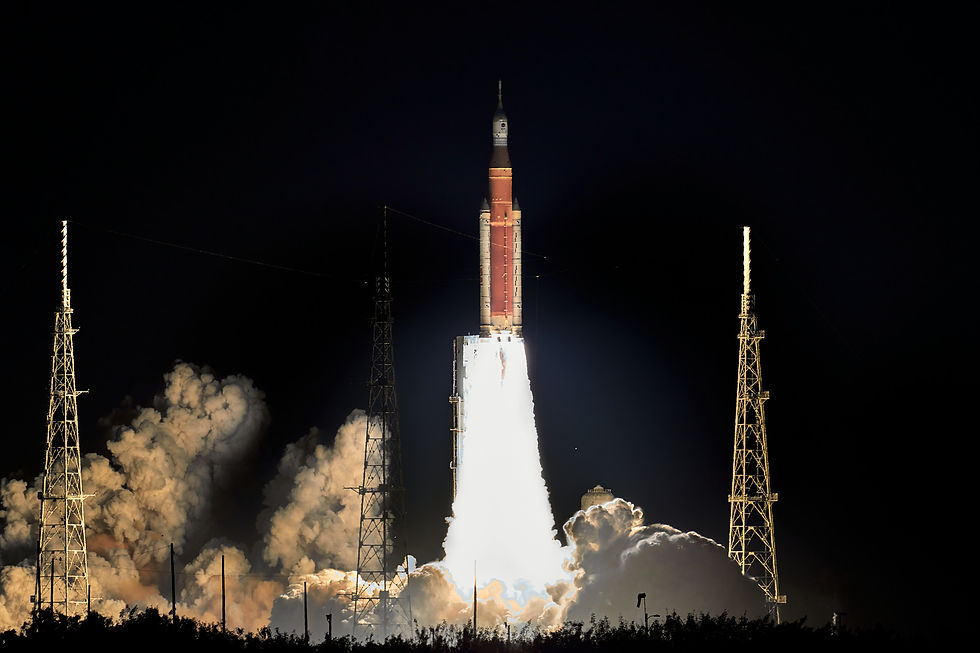
On November 18th 2022, in the blackness of night, the brightest rocket launch in history lifted off from the historic Pad 39B at Kennedy Space Center. Artemis I engines and solid rocket boosters burned bright igniting a new chapter in human spaceflight.
Both those who witnessed Apollo and the dreams it carried, and those who watched Artemis launch for the first time into the night with the moon rising in the background, were left speechless. After all these years, humans were finally returning not just to low Earth orbit but to the Moon and, eventually, beyond.
To the Moon
Artemis I in addition to end to end system testing, tested the new higher crew capacity Orion capsule, a critical test to ensure we return astronauts safely to Earth. The Orion capsule traveled a record 268,563 miles away from Earth. Not just to the Moon, but beyond and in fact, the furthest distance for a human spaceflight rated spacecraft in history.

Return to Earth
The Artemis I Orion capsule splashed down in the Pacific Ocean on December 11th, 2022. A safe return to Earth, as President Kennedy demanded of America's space program over 50 years ago, and the start of the mission to establish permanent human presence on the Moon.

Our parents told us we could be anything we wanted to be, do anything we set our minds to. In 1969 NASA delivered, anything was possible. In 2022, NASA delivered again, inspiring new generations to believe they can be anything they want to be.
This time however, NASA has a new mission; to go, to stay, and prepare to go beyond.
