top of page
Search

Crew-13 Prepares for Journey to the International Space Station

Updated: 6 days ago

Launch Date Set: No Earlier Than September 12, 2026


The SpaceX Crew-13 members are pictured in their pressure suits seated inside a mockup Dragon spacecraft during a preflight training session at the company's headquarters in Hawthorne, California. From left are, Roscosmos Sergey Teteryatnikov, NASA astronauts Luke Delaney and Jessica Watkins, and CSA (Canadian Space Agency) astronaut Joshua Kutryk. Credit: SpaceX

From Johnson Space Center in Houston earlier this week, Crew-13 was formally introduced and discussed the team's readiness as they prepare for a targeted launch no earlier than September 12, 2026, at 6:34 p.m. EDT from Space Launch Complex 40 at Cape Canaveral Space Force Station in Florida.


While teams continue preparing the Falcon 9 launch vehicle, SpaceX has mated the Dragon spacecraft Grace (C213) with its trunk, bringing the spacecraft one step closer to flight. The crew’s next milestone will be a full launch rehearsal, where they will climb aboard Dragon and practice the journey that will carry them to the International Space Station. The Falcon 9 second stage is moving through the final stages of assembly. Following completion of processing, the integrated Dragon spacecraft will be transported to the launch site for static fire testing.


MRAPs during integrated system verification and validation tests at KSC’s Launch Pad 39B, Aug. 8, 2024.   Credit: NASAA/Kim Shiflett.
MRAPs during integrated system verification and validation tests at KSC’s Launch Pad 39B, Aug. 8, 2024.  Credit: NASAA/Kim Shiflett.

SpaceX has made a significant change to its launch pad emergency response capability by replacing the MRAP (Mine-Resistant Ambush Protected) rescue vehicles with its own fleet of Tesla Cybertrucks. While SpaceX has not publicly confirmed whether the vehicles have been outfitted with specialized rescue equipment beyond their standard configuration, NASA has stated that they have undergone the necessary inspections and are approved for use in launch operations. Their primary advantage is speed, allowing emergency response teams to evacuate astronauts from the hazard area more quickly than was possible with the larger, heavier MRAPs. “The speed at which a Cybertruck can exit the blast danger area is definitely one of the reasons why SpaceX has chosen to go in that direction, but I think really the main thing that I want to iterate is that it decouples a conflict in terms of trying to compete for the same resources for an MRAP for the personnel associated with those operations.” - Richard Jones, Deputy Program Manager, Commercial Crew Program, NASA


Another notable update is the introduction of SpaceX's R3 pressure suits. The latest generation of spacesuits is lighter, more comfortable, and easier for astronauts to don and operate than previous versions, reflecting continued refinements based on operational experience from earlier Crew Dragon missions.


Meet The Crew


For Commander Jessica Watkins, Crew-13 marks a new chapter in her astronaut career. After spending more than five months aboard the International Space Station as a mission specialist, Watkins returns to orbit as commander, bringing her expertise as a geologist, researcher, and astronaut leader to guide the next expedition aboard the ISS.


Luke Delaney, Crew-13 represents the next chapter in a career defined by flight testing and exploration. After years as a naval aviator, test pilot, and NASA research pilot, Delaney will make his first journey into space as Crew Dragon's pilot.


Joshua Kutryk, Crew-13 represents the realization of a lifelong pursuit of exploration. After years as a Royal Canadian Air Force fighter pilot, test pilot, and astronaut, Kutryk will make his first journey into orbit, continuing Canada's legacy of contributing science, technology, and human expertise to the International Space Station. Kutryk will be welcoming the birth of a child while he is in orbit.


Sergey Teteryatnikov, a Roscosmos cosmonaut, will make his first journey to the International Space Station aboard Crew-13. Selected as a cosmonaut candidate in 2018, Teteryatnikov brings a background in engineering and aerospace operations to the mission.


The SpaceX Crew-13 members pose for a portrait in their pressure suits during a preflight training session at the company's headquarters in Hawthorne, California. From left are, Roscosmos Sergey Teteryatnikov, NASA astronauts Jessica Watkins and Luke Delaney, and CSA (Canadian Space Agency) astronaut Joshua Kutryk. Credit: SpaceX

CSA (Canadian Space Agency) astronaut Josh Kutryk (left) and NASA astronaut Luke Delaney (right), with assistance from training specialists, practice suiting up in spacesuits in an International Space Station airlock simulator at Johnson Space Center’s (JSC) Space Vehicle Mockup Facility in Houston, Texas. Astronauts familiarize themselves with spacesuit systems and procedures and practice Quest airlock operations before conducting spacewalk training at JSC’s Neutral Buoyancy Laboratory in simulated microgravity.  Image Credit: NASA/Josh Valcarcel
CSA (Canadian Space Agency) astronaut Josh Kutryk (left) and NASA astronaut Luke Delaney (right), with assistance from training specialists, practice suiting up in spacesuits in an International Space Station airlock simulator at Johnson Space Center’s (JSC) Space Vehicle Mockup Facility in Houston, Texas. Astronauts familiarize themselves with spacesuit systems and procedures and practice Quest airlock operations before conducting spacewalk training at JSC’s Neutral Buoyancy Laboratory in simulated microgravity. Image Credit: NASA/Josh Valcarcel

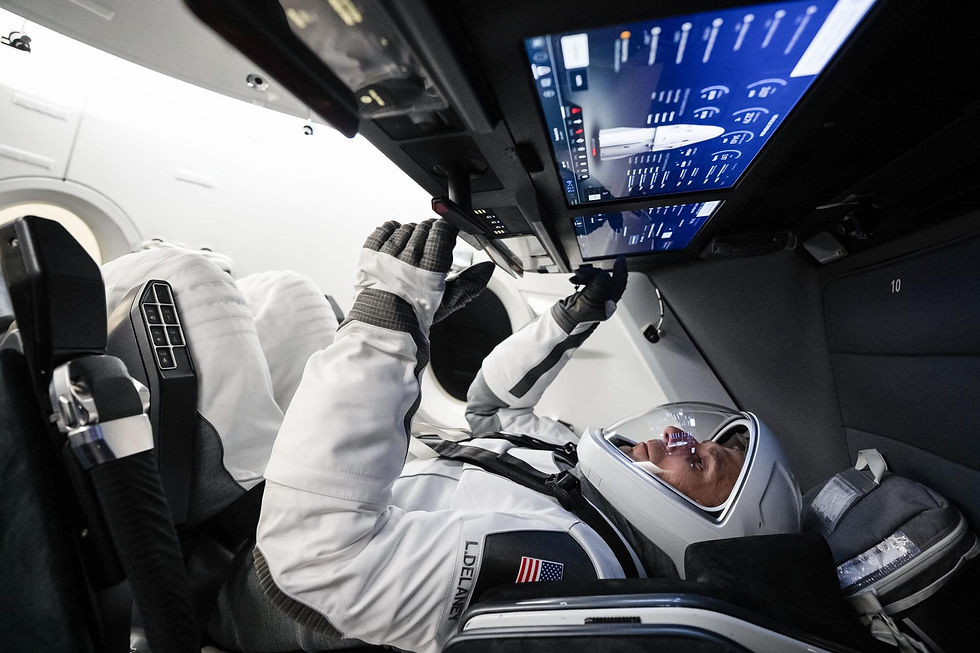
NASA astronaut and SpaceX Crew‑13 Pilot Luke Delaney sits inside a Dragon spacecraft mockup while tapping a cockpit screen interface during a pre‑flight training session at SpaceX headquarters in Hawthorne, California.  Image Credit: SpaceX
NASA astronaut and SpaceX Crew‑13 Pilot Luke Delaney sits inside a Dragon spacecraft mockup while tapping a cockpit screen interface during a pre‑flight training session at SpaceX headquarters in Hawthorne, California. Image Credit: SpaceX
NASA’s SpaceX Crew-13 patch looks ardently toward the future of space exploration while honoring the legacy of those who came before. The central golden dragon harkens back to Apollo 13, embodying resilience and gazing upward to the dawn of a new era of discovery. The tail contours around Earth in an embrace, highlighting the interconnected nature of human spaceflight and celebrating the collective efforts of the teams who make it possible. The wings, outstretched to form a bridge between Earth, the International Space Station, the Moon, and Mars, reflect the continuity between low Earth orbit and destinations to come. Gold stars burn brightly, representing the crew’s families and support systems as a tribute to their immense contributions to this endeavor. All of these themes are unified within a distinctive capsule silhouette, symbolizing the limitless possibilities born out of human collaboration toward a common goal. Credit: NASA


bottom of page