
Roman: A New Era of Discovery Begins

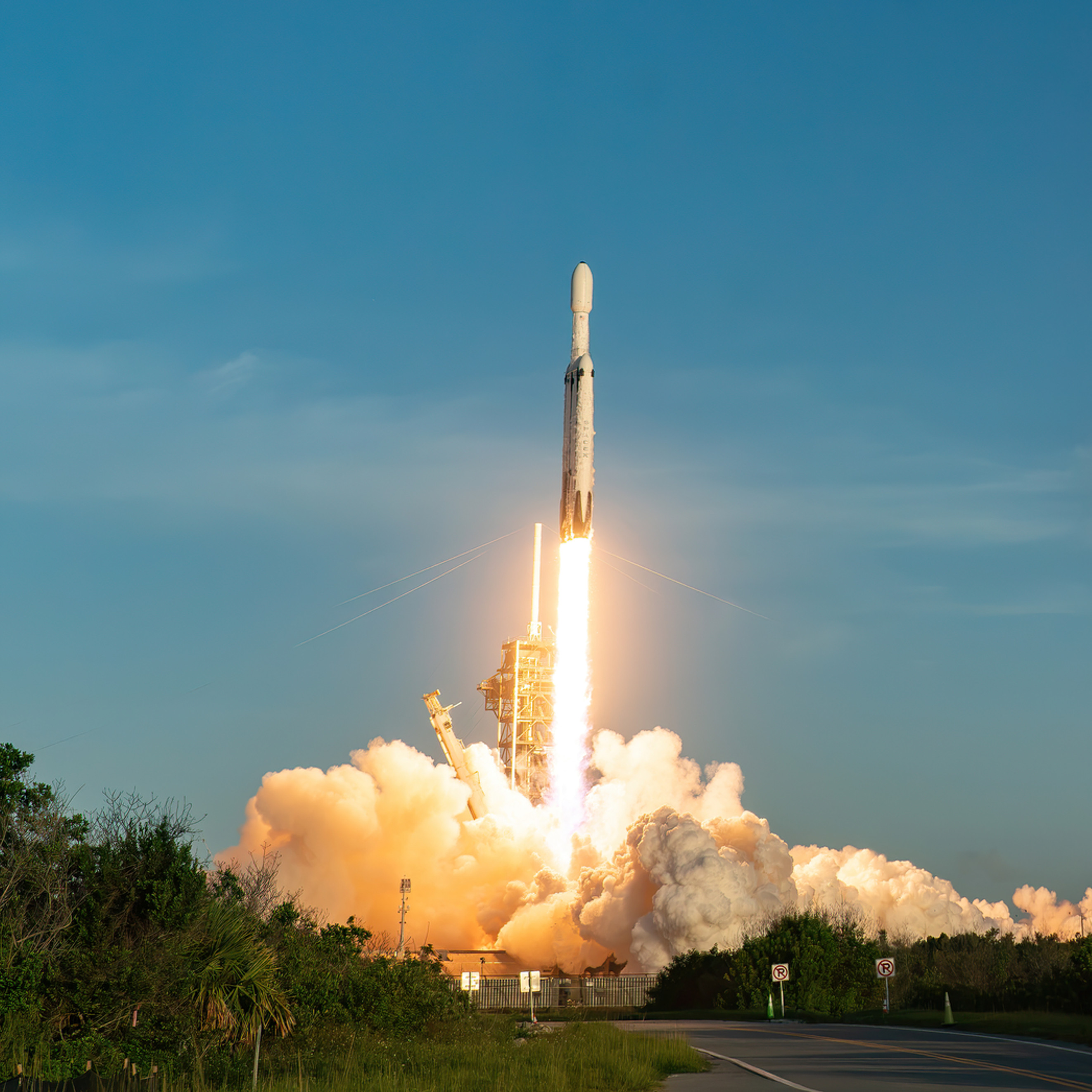
Yesterday marks a promising step forward with the successful launch of the Nancy Grace Roman telescope on a SpaceX Falcon Heavy from Launch Complex 39A at Kennedy Space Center in Florida at 7:26 am EDT. Two of Falcon Heavy's boosters needed for this heavy lift transported NASA's Flagship Mission payload through the atmosphere. After completing their mission, they detached and returned to Landing Zone 40 and Landing Zone 2 for reuse, providing spectators with a double sonic boom during their re-entry.

Falcon Heavy delivered Roman on the necessary trajectory to reach the Sun-Earth L2 (Lagrange Point 2) region, located about one million miles (1.5 million kilometers) from Earth. Here, it successfully deployed the Roman observatory on its path to L2. Upon reaching this point, the observatory will enter a detailed commissioning phase, during which engineers and scientists will thoroughly check the performance of each spacecraft subsystem and science instrument before commencing regular science operations.
This is the estimated post launch timeline:
5 hours: Solar panels and sunshade deploy
2 days: High-gain antenna deploys and deployable aperture cover is released
1 week: Coronagraph instrument activates
3 weeks: Wide field instrument powers on and completes initial checkout
4 weeks: Fine guidance sensor check out
4 weeks: Coronagraph instrument tests
2 months: Instruments complete alignment and focus
2-3 months: Science commissioning complete, FIRST LOOK observations released and science operations begin
3-4 months: Orbit insertion (after baseline science mission phase begins)
Roman is equipped with propellant reserves intended to sustain at least five years of precise orbital maneuvers, ensuring the flexibility required to optimize its scientific yield throughout the mission. Additionally, Roman is constructed to accommodate robotic servicing in the future, provided we can develop servicing vehicles capable of reaching L2.
To put it into context, the Roman space telescope itself is the size of a tour bus, weighs approximately as much as a T-Rex, and is the most stable telescope ever flown. "It will be as if Hubble and James Webb kind of peered through a keyhole at the universe, well Nancy Grace Roman kicks the door down." said Dr. Nicky Fox, Associate Administrator, NASA Science.
How Is Roman Different Than Hubble
Roman will orbit 1 million miles from Earth while Hubble orbits 340 miles from Earth
Roman can capture in one month what would take Hubble a century
While their primary mirrors are the same size, Roman's is 1/4 the weight
Roman's WFI (Wide Field Instrument) is significantly larger which can create enormous cosmic panoramas
Roman is optimized for wide-field infrared surveys, while Hubble is much more versatile for detailed observations across ultraviolet, visible, and some near-infrared light
How Is Roman Different Than James Webb
So the next question you might ask is since James Webb is the newer observatory and it is sitting out at L2, what can Roman bring to the table that will be new and amazing?
Roman is intended for wide-field surveys while James Webb is for deep and very detailed observations
Roman's main wavelength is near infrared and some visible and James Webb is primarily infrared
While Webb can detect and study individual gravitational microlensing events, Roman is designed to monitor enormous numbers of stars simultaneously, giving it a much greater opportunity to discover microlensing events and the planets they reveal (a technique used to be able to objects normally too faint to detect)
When these observatories are all working together, their complementary strengths can maximize what we learn from the same celestial objects.
A Look At The Wide Field Instrument

From NASA: The Nancy Grace Roman Space Telescope will create enormous cosmic panoramas. This infographic shows how the mission's primary detector, the Wide Field Instrument (WFI), will help astronomers explore the infrared universe. The Roman Space Telescope's expansive surveys will help answer some of the most compelling questions in astrophysics and reveal many interesting targets for follow up by other missions.
Respectively, The James Webb Space Telescope is an orbiting infrared observatory that will study every phase in the history of our universe. The infographic on the left below highlights the mission’s primary imager, the Near Infrared Camera (NIRCam). Using NIRCAM and its other instruments, Webb will provide high-resolution observations of an array of cosmic objects.
The Hubble Space Telescope provides a high-resolution view of the cosmos in infrared, visible and ultraviolet light. The infographic on the right highlights some of the telescope’s key features, specifically focusing on the Wide Field Camera 3 instrument. Using this instrument and others, Hubble has transformed our understanding of the universe for three decades and will continue to answer astronomical questions for years to come.
Credit: NASA's Goddard Space Flight Center Credit: NASA's Goddard Space Flight Center
A Look At The Coronagraph Instrument
Unlike a typical coronagraph that uses an opaque disk to block a star's light, Roman's active coronagraph employs a system of masks, prisms, detectors, and two self-adjusting mirrors. These mirrors are equipped with 1400 pistons on the back of each. This setup is designed to create destructive interference with the star's light, enabling light from planets to pass through. By eliminating this glare, it can uncover planets orbiting the star that are billions of years old.
Using the Kepler's Laws of Planetary Motion, it will monitor for possible orbiting planets of the stars it studies. It will also be able to use the microlensing technique where it will rely on gravitational fields of a massive object like a star acting as a lens to magnify the light from a more distant and fainter background star.
It will not yet be able to detect Earth-like planets with the current technology, but it is the hope for Roman to be the first to ever image a Jupiter-like world. The intention is to successfully demonstrate its potential where Roman then will be the stepping stone for future observatories to be able to then begin the process of finding habitable worlds.
This is an oversimplification. There are many other pieces working together here onboard an incredibly stable telescope. All of these systems will be working together with the coronagraph to achieve its objectives. With these demonstrations, Roman will begin to pave the way for future missions like NASA's Habitable Worlds Observatory to begin to identify and study worlds that may be more like our own.
Roman's Goals
There is a lot to digest here. Roman will be hard at work after deployment, but what are the main goals of this observatory? Planning the first five years of Roman's observations all at once was quite the feat. We want to begin to understand dark matter and dark energy, and where we come from. The team developed three core surveys.

Galactic Bulge Time-Domain Survey which is tracking how stars change in brightness over time. This is used to discover distant worlds and rogue planets and stellar-mass black holes.
Imaging Exoplanets where Roman will demonstrate its imaging technology by observing worlds the size of Jupiter that circle Sun-like stars, and photographing planets billions of years old.
General Astrophysics where Roman's core surveys will aid in untangling dark energy secrets and begin to discover new worlds.
With these three surveys, teams will work toward answering many of their long awaited questions, and then some. Roman will continue to work years beyond the five-year plan as new discoveries are made.
All That Data
The best part is, within 2-3 months after today's launch, everyone may be getting a peek at some of the first images Roman has captured as it shares its data with the world in its staggering data dump of 1.4 Terabytes per day.
We now understand what Roman is capable of capturing, and the scale of that data, the size of the image files we will be able to view, and how quickly how that data will become available to all of us. What we haven't considered is that these images must first be processed: calibrated, color balanced, aligned, and made searchable for end users before being loaded into an easy and intuitive cloud-based system on a time scale of around one day.
This system was introduced as Roman Research Nexus where users will be able to log in and analyze any part of Roman's data at any time. Imagine using it in a similar way as an online map navigation tool where you can zoom in down to a neighborhood or zoom out to a world view, this is the promise of the Nexus. It's data will continue to be reworked and re-released as newer processing tools are developed and as Roman gains more time on stars.
This data will be available at the same time for everyone. The range of Roman’s data will be extraordinary, from helping scientists study dark energy, exoplanets, and the evolution of galaxies; thus allowing students, educators, amateur astronomers, and the public to explore and discover objects across an enormous portion of the sky. If you are excited enough about exploring the data yourself and want to dig in, follow NASA's Citizen Science Projects and watch for the opportunities that will arise from Roman to see what you may discover.
Nancy Grace Roman was an American astronomer and a pioneering leader instrumental in developing the United States' civilian space program. From the Yerkes Observatory in Wisconsin where she both studied and taught astronomy, to eventually NASA, where she became the agency's first Chief of Astronomy and its first female executive, she led a distinguished career in the field of astronomy.
Her influence on space science was extraordinary. She played a pivotal role in making the Hubble Space Telescope a reality and is still widely known as the “Mother of Hubble.” Her legacy continues today through the Nancy Grace Roman Space Telescope, which carries her name and her vision for the future of astronomy
In 1959, Nancy Grace Roman was already looking beyond the limits of Earth-based astronomy. In her paper “Planets of Other Suns,” she explored how observing from space, or even from the Moon, could open possibilities that were impossible from Earth. More than six decades later, a space telescope is now bearing her name and it will push those boundaries even further, surveying enormous portions of the sky and creating a data set that could reveal discoveries no one has yet imagined. I wonder if she could have imagined this?
If you want to see more about Roman, you can follow along on NASA's blog.
EXPLORE ROMAN YOURSELF with NASA's interactive diagram.


