
Titan and the Dragonfly

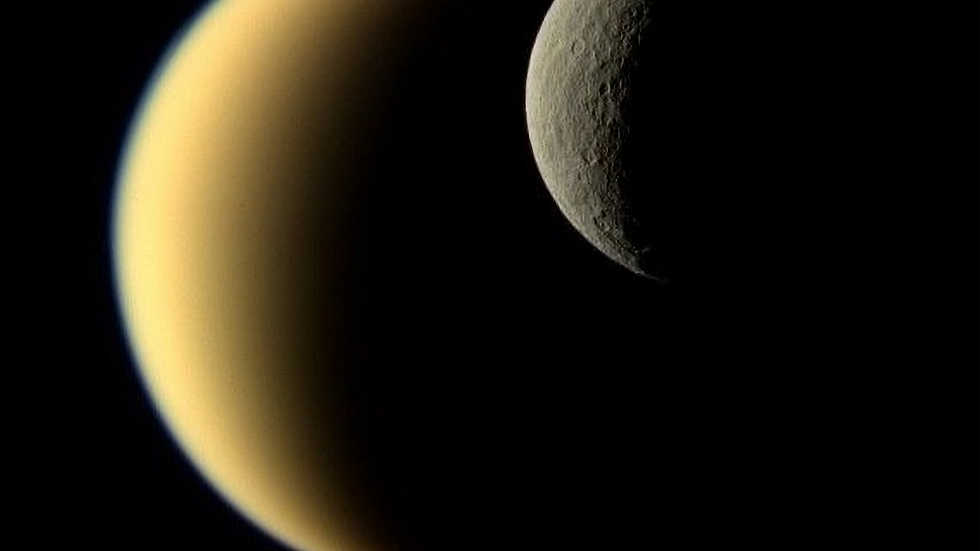
Saturn's Largest Moon
Saturn, roughly 886 million miles from the Sun, orbits our star with 293 moons, more than any other planet in our solar system. One of those moons has captured scientists' attention above all others. Titan, Saturn's largest moon, is larger than Earth's moon, larger than the planet Mercury, and slightly smaller than Ganymede, Jupiter's largest moon.
Titan's orbit of Saturn, also referred to as a Titan day or (Tsol), is equivalent to 15 Earth days and 22 Earth hours. Understanding Titan's orbital period and rotation relative to Earth is critical to support future spacecraft communications to Earth. For example, the NASA New Frontiers Mission, Dragonfly, will need to transmit data to Earth every 8 Earth days.
But it isn't the distance from the Sun, from Saturn, or the size of Titan that captures imaginations. Titan's traits are closer to Earth than perhaps any other celestial body we know of in our solar system. A thick atmosphere of nitrogen, low surface pressure equivalent to 50 feet underwater here on Earth, liquid lakes of methane on its surface, and a potential subsurface ocean. In fact, like Earth, it is the only planet or moon in our solar system with liquids on its surface and an Earth-like cycle of water.
A Parade of Robots
From Pioneer 11's flyby in 1979, to Voyager 1 in 1980 and Voyager 2 in 1981, and finally the Cassini-Huygens first Titan flyby in 2004, each mission has progressively revealed more of Titan's remarkable world.
Then in 2005, Huygens became the first man-made object in history to land on the surface of Titan. Huygens' 2.5 hours of operation on the surface only served to generate even more scientific interest and, of course, questions. And now at the end of this long parade of robots, Dragonfly.
The first nuclear-powered octocopter mission was approved in 2019. However, there will be no flyby, no orbit, and no roving on this mission. Dragonfly will fly, land, and then fly again. Initial planning suggests Dragonfly could travel up to 175 kilometers total over the course of its prime mission. For perspective, Curiosity, the Mars Science Lab mission, notably also nuclear-powered, landed on Mars in 2012, and as of this writing has covered an unprecedented ~37 kilometers over its amazing 14 years on the red planet.
For Titan, a first: a nuclear-powered rotary-wing scientific laboratory, autonomously relocating itself to investigate Titan's atmosphere, surface chemistry, weather, and the building blocks of life itself.

