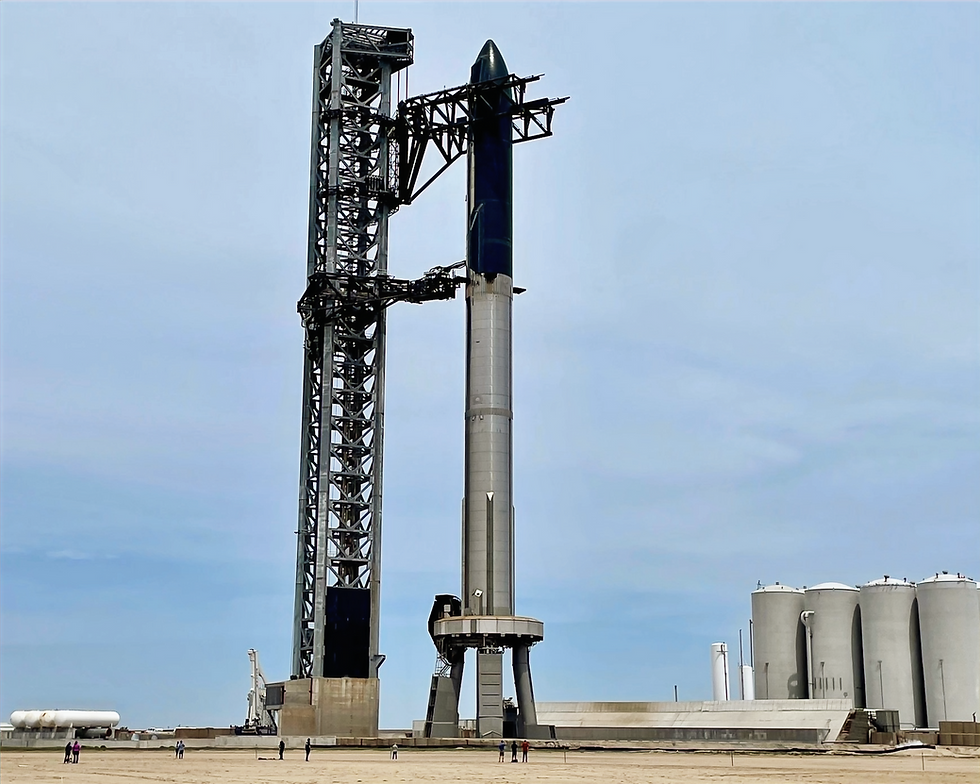
Lucky 13

Updated: Jul 30

Lucky, good fortune, yes, after years of preparation.
Starship 13 represents a significant step forward from Starship Integrated Flight Test 1 (IFT-1). Those who witnessed IFT-1 remember holding their breath as she hesitated, three engines failing to ignite, then ever slowly climbing above a 400 foot cloud of dust and debris. When IFT-1 emerged, a noticeable sigh of relief followed immediately by awe rippled through the everyone who watched the largest rocket in history take flight. For many a sense humanity was on its way to a multi-planetary existence. IFT-1 cleared the tower and ultimately achieved a rapid unscheduled disassembly down range. Mission complete.
On July 24th, 2026, Starship 13 leaped off the orbital launch mount (OLM) all 33 engines firing, seemingly impatient to leave in stark contrast to IFT-1, which clung to the OLM for an excruciatingly long 8 seconds.
13, representing the third iteration of the design, delivered a near flawless launch end to end. All 33 booster engines fired, a T+00:00 launch, a clean hot stage, a soft booster landing, a smooth Starlink v3 satellite deployment, and then a soft landing in the Indian Ocean.
Starship Flight 13 marks an important milestone in advancing NASA's goal of establishing a lasting human presence on the Moon and beyond, as well as SpaceX's ambition of creating a multi-planetary species. With the success of Flight 13, anticipation and excitement are already increasing. For SpaceX, the next phase of increased requirements and expectations for Starship 14 has begun.